Chimney Inspection
A documented look at the flue, firebox, crown and flashing so you know the real condition.
See chimney inspectionFixes that keep a chimney in service
Crown, damper, firebox, smoke chamber and chase cover repairs — diagnosed properly before anything is quoted.
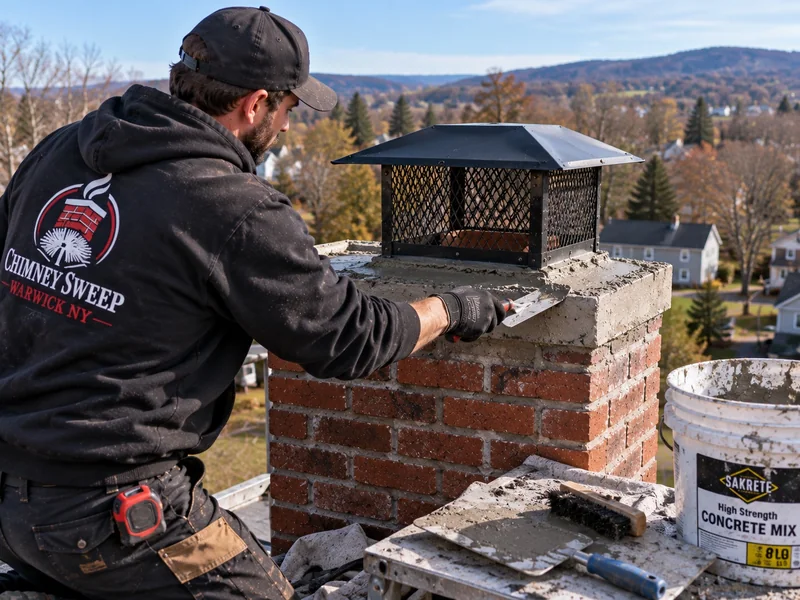
Chimney repair covers the fixes that fall between annual maintenance and a full rebuild: a cracked crown, a damper that won't seat, a firebox with failed joints, a smoke chamber that was never finished properly, or a stack that's taken on water for years. These repairs are what actually keep a chimney in service.
The crown is the concrete slab at the top that sheds water away from the flue and the brickwork below. It should be sloped, extend past the brick, and have an expansion joint around the flue tile. Many aren't built that way — a flat smear of mortar cracks within a few winters. Small cracks can be sealed with a flexible crown coating; a crumbling crown gets cut off and recast.
Throat dampers rust, warp and lose their seal. When one won't close, conditioned air goes up the flue year-round; when it won't open fully, the fire smokes. Rebuilding the existing assembly is sometimes possible. Where it isn't, a top-sealing damper mounted at the crown is usually the better answer — it seals with a gasket and keeps water and animals out at the same time.
Masonry fireboxes lose mortar joints over time and the firebrick face cracks. Open joints let heat reach the brick behind and eventually the framing. Repointing with refractory mortar, replacing spalled firebrick and rebuilding the back wall are all common. Prefabricated fireboxes are different: cracked refractory panels are replaced with manufacturer-specified parts, not patched, and a panel that can't be sourced means the unit is done.
Above the damper, the smoke chamber funnels smoke into the flue. Many were built with corbelled brick left rough, with voids between the steps. That turbulence hurts draft and the voids let heat move toward framing. Parging the chamber smooth with refractory mortar fixes both — it's one of the more satisfying repairs because the improvement in how the fireplace drafts is immediate.
On prefabricated chimneys, the chase cover is the metal lid on the framed chase. Galvanized covers rust through and then rain pours straight into the chase. Stainless replacements, fabricated to the chase dimensions with proper slope and drip edge, solve it permanently.
Every repair quote starts from an inspection, because the visible symptom and the actual cause are often in different places. Stained plaster beside the fireplace can be a cracked crown, failed flashing, or a missing cap — three different repairs with different prices. We find the source before quoting the fix.
Then we sort the work into three buckets and tell you which is which:
Repair makes sense when the structure is sound and specific components have failed. Rebuilding the top section becomes the honest answer when mortar joints are soft through the upper courses, brick faces are spalling on multiple sides, or the stack is visibly out of plumb. Patching a chimney that's failing structurally is money spent twice — we'll say so rather than sell the smaller job. Where the masonry itself is the problem, see masonry repair and repointing.
Water is behind most chimney repairs. Freeze-thaw cycling through a Hudson Valley winter drives water into brick and mortar, freezes it overnight, and breaks the material apart from the inside. Fixing the crown, cap and flashing is what keeps every other repair from coming back.
Masonry repairs need temperatures above roughly 40°F for mortar and concrete to cure properly, which limits what can be done from late fall into spring. Component work — dampers, chase covers, caps, some liner work — can usually be handled year-round. If something needs to happen in January, we'll tell you what's possible now and what should wait for the thaw.
Often, yes. Crown recasting, repointing the top few courses, replacing a damper or rebuilding a firebox are all component repairs. What doesn't work is patching over a structural problem.
Crown work and damper replacement are typically a single day. Firebox rebuilds and partial masonry rebuilds run longer and depend on weather and cure time.
For interior work — firebox, damper, smoke chamber — yes, we need access. Exterior crown, cap and flashing work can often be done without anyone home if access is arranged.
We match brick and mortar color as closely as available materials allow. On older homes, exact matches aren't always possible and we'll show you samples before starting.
Our work carries a 90-day warranty. If a repair we made isn't holding, call and we come back out. Parts and liners carry their own manufacturer warranties on top of that.
A documented look at the flue, firebox, crown and flashing so you know the real condition.
See chimney inspectionRepointing, brick replacement and rebuilds for chimneys worn down by freeze-thaw.
See masonry repairFinding the actual entry point — crown, flashing, brick face or cap — and sealing it.
See chimney leak repairWe are based in Warwick and also sweep chimneys in these nearby communities.
Call (845) 685-9770 or send a request with your address and what the chimney is doing.