Chimneys in the Hudson Valley fail from the top down, and the reason is almost always water combined with cold. Understanding the mechanism makes the repair recommendations make sense.
The freeze-thaw cycle
Brick and mortar absorb water. When that water freezes it expands about nine percent, and it has to push something out of the way. Do that repeatedly through a winter of days above freezing and nights below, and the material breaks apart from the inside — face by face, joint by joint.
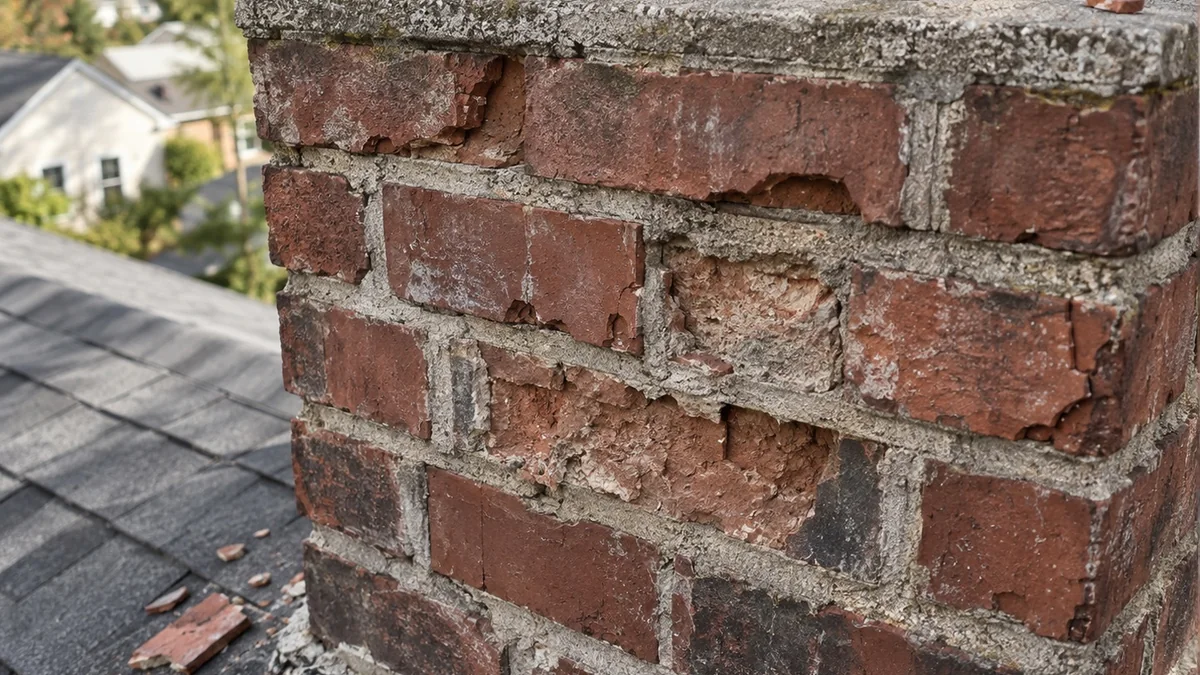
The chimney takes the worst of it because it's exposed on all four sides with nothing above it, and the top courses sit in whatever the weather does. That's why damage is concentrated in the last few feet of the stack.
What makes it worse
A failed crown
The crown is supposed to shed water away from the flue and past the brick. A flat, thin mortar wash with no overhang and no expansion joint cracks early and feeds water into the masonry below.
No cap
Rain down the flue wets the chimney from the inside as well as the outside.
The wrong mortar
This one is subtle and it destroys old chimneys. Modern high-portland mortar is harder than the soft brick used on antique buildings. Since mortar joints are supposed to be the sacrificial element, harder mortar forces the brick to take the stress instead — and the brick faces spall. Older homes need a softer lime-based mix. Getting this wrong is the most common way a well-intentioned repointing job makes things worse.
Film-forming sealers
Coatings that form a surface film trap moisture inside the masonry. The next freeze has more water to work with, not less. Breathable, vapor-permeable repellents are the alternative.
Deferred repointing
Open joints are an invitation. Once water has a path in, the process accelerates.
Stages of masonry failure
- Efflorescence. White chalky deposits — evidence of water moving through the masonry. Nothing is broken yet.
- Joint erosion. Mortar recedes and softens; you can scrape it out with a key.
- Spalling. Brick faces pop off, exposing porous interiors that absorb faster.
- Structural movement. Stepped cracking, lean, gaps at the roofline.
Each stage costs more to correct than the one before. Repointing at stage two is a day of work; a rebuild at stage four is a project.
What the repairs look like
- Repointing — grinding out failed joints and replacing them with mortar matched to the original
- Brick replacement — cutting out spalled units and matching replacements as closely as available
- Partial rebuild — taking the stack down to sound masonry and rebuilding, usually with a new crown and cap
- Crown recasting — a properly sloped crown with overhang and an expansion joint
- Breathable waterproofing — applied after repairs, never as a substitute
Timing
Mortar needs temperatures above roughly 40°F to cure, so masonry season here runs from spring into late autumn. A chimney that's actively deteriorating in January can sometimes get a temporary protective measure, but the real work waits for the thaw. Which is an argument for having the annual sweep done in summer, when repairs can still be scheduled in the same season.
The cheapest masonry repair is the one you do at stage two. Soft joints with sound brick means repointing. Once the brick faces are going, you're into replacement or rebuild — several times the cost, for the same underlying cause.
Quick answers
Is efflorescence a serious problem?
The deposit itself is harmless. What it indicates — water moving through the masonry — is what matters, because in a freezing climate that's the beginning of spalling.
Can I repoint a chimney myself?
Small areas at ground level, maybe. Height, matching mortar strength and color, and correct joint depth are where DIY repointing usually goes wrong — and mismatched mortar damages brick.
How long should repointing last?
Properly matched and correctly installed, decades. A mortar that's too hard for the brick can cause visible damage within a few winters.
Need someone to look at it? Chimney Sweep Warwick NY covers Warwick and the surrounding towns. Call (845) 685-9770 or send a service request.